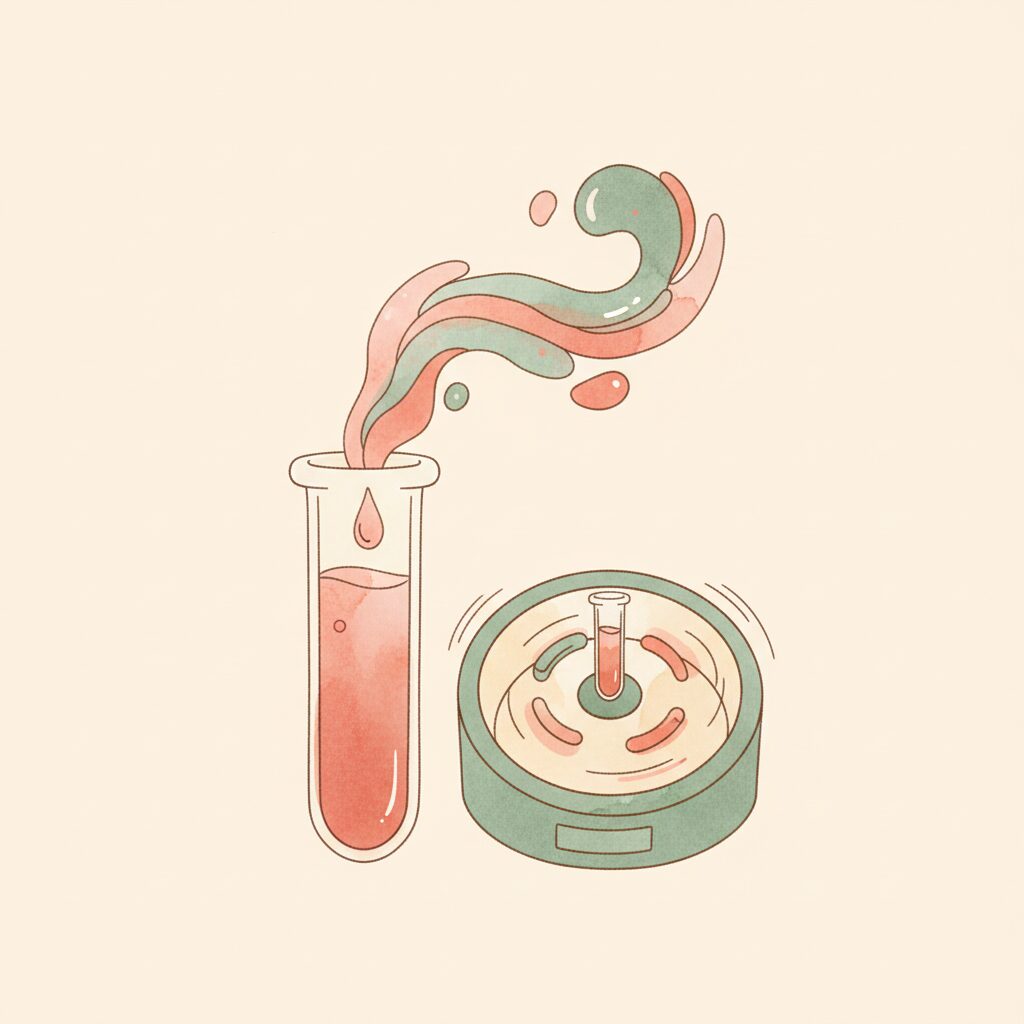
What is PRP?
PRP (platelet-rich plasma) is a small volume of plasma in which the platelet concentration has been increased several-fold by laboratory processing. Platelets carry growth factors — small signalling proteins (VEGF, PDGF, TGF-β, EGF) that support cell proliferation, vascular development, and tissue repair. When concentrated PRP is injected into a tissue, those growth factors are delivered locally, in a much higher dose than the body normally provides.
In fertility, PRP is used in two main contexts: ovarian PRP for diminished ovarian reserve (where the goal is to wake up dormant follicles), and intrauterine PRP for thin endometrium or refractory Asherman syndrome (where the goal is to thicken and revascularise a lining that hasn't responded to standard hormonal preparation).
Ovarian PRP — for diminished ovarian reserve
Under ultrasound guidance, PRP is injected directly into the ovarian cortex. The hypothesis is that local growth factors stimulate dormant primordial follicles to activate — potentially restoring some ovarian function in women with low AMH or even premature ovarian insufficiency.
The reality, honestly: evidence is encouraging but not conclusive. Several small studies report:
- Resumed ovulation in some women with previously absent cycles.
- Modest AMH improvement.
- Occasional spontaneous pregnancies after PRP.
We don't yet know which patients are most likely to benefit, how long benefit lasts, or whether the effect is real on a population scale. Larger randomised trials are still needed.
Intrauterine PRP — for thin endometrium and Asherman
PRP is instilled into the uterine cavity through a thin catheter, similar to an IUI procedure. The hypothesis: growth factors directly stimulate the endometrial cells, improving thickness, vascularity, and receptivity.
The evidence here is more consistent. Multiple studies show:
- Measurable increase in endometrial thickness (typically 1–2 mm) in women with refractory thin endometrium.
- Higher subsequent embryo transfer pregnancy rates in patients whose lining had not responded to standard protocols.
- Encouraging results in Asherman syndrome alongside hysteroscopic adhesiolysis.
Intrauterine PRP for thin endometrium has stronger evidence than ovarian PRP for diminished reserve. Both are still considered emerging therapies.
How PRP is prepared — step by step
- Blood draw — 20–60 mL of peripheral blood drawn into an anticoagulant tube.
- Centrifugation — separates plasma (top), platelet-poor plasma (middle), and red cells (bottom).
- Concentration — the platelet-rich layer is isolated. Final PRP volume is typically 3–6 mL.
- Application — either ovarian injection under ultrasound guidance (ovarian PRP) or intrauterine instillation (uterine PRP) on a scheduled day of the cycle.
Cost in Hyderabad
Ovarian PRP: ₹25,000–₹50,000 per session in Hyderabad in 2026, including processing, anaesthesia, and ultrasound-guided injection. Intrauterine PRP: ₹10,000–₹20,000 per cycle.
Limitations and risks
- Evidence is preliminary. Most studies are small and short-term.
- Not every woman benefits. We can't yet predict who will.
- Procedure risks are low — the materials are from your own blood, so there's no immune or infectious risk from a donor. Procedural risks (bleeding, infection from the injection itself) are very low with good technique.
- Does not reverse menopause. Realistic counselling matters.
How I work
I offer PRP selectively, after honest conversation about the evidence and your specific picture. For diminished ovarian reserve in a younger woman with declining AMH, ovarian PRP can be reasonable to try before donor eggs. For refractory thin endometrium after multiple failed IVF cycles, intrauterine PRP often has better evidence than another standard cycle.
What I won't do: market PRP as a guaranteed solution, charge for repeated sessions without clear evidence of response, or pretend the evidence is more settled than it is.
Wondering if PRP fits your situation?
A consultation will tell us honestly whether the evidence supports trying PRP in your specific picture.
Frequently asked questions
The questions patients ask me most often about PRP.
Does ovarian PRP work?
Evidence is preliminary, encouraging but not conclusive. Small studies show resumed ovulation, modest AMH improvement, occasional pregnancies in DOR and even POI. Larger trials still needed.
How is PRP prepared?
A blood sample (20–60 mL) is centrifuged to separate platelet-rich plasma from red cells and platelet-poor plasma. The concentrated PRP is the working sample.
Is it painful?
Ovarian PRP under sedation, similar to egg retrieval. Mild cramping for a day or two after. Intrauterine PRP is comfortable, like an IUI.
How many sessions are needed?
Ovarian: 1–3 sessions before assessing response. Intrauterine: 1–3 instillations within a single embryo transfer preparation cycle.
Can it bring back cycles in premature ovarian failure?
Case reports describe it, but the proportion is likely small. Not a guaranteed cure for POI — but for selected patients a reasonable option to discuss.
Does PRP help with thin endometrium?
Stronger evidence here than ovarian PRP. Multiple studies show measurable improvement in lining thickness and pregnancy rates in refractory thin endometrium.
What does it cost in Hyderabad?
Ovarian PRP: ₹25,000–₹50,000 per session. Intrauterine PRP: ₹10,000–₹20,000 per cycle.
Should I try PRP before donor eggs?
For some women with DOR, trying 1–2 cycles of ovarian PRP before donor eggs is a reasonable conversation. Evidence is preliminary but procedure is safe (your own blood). We discuss it honestly.