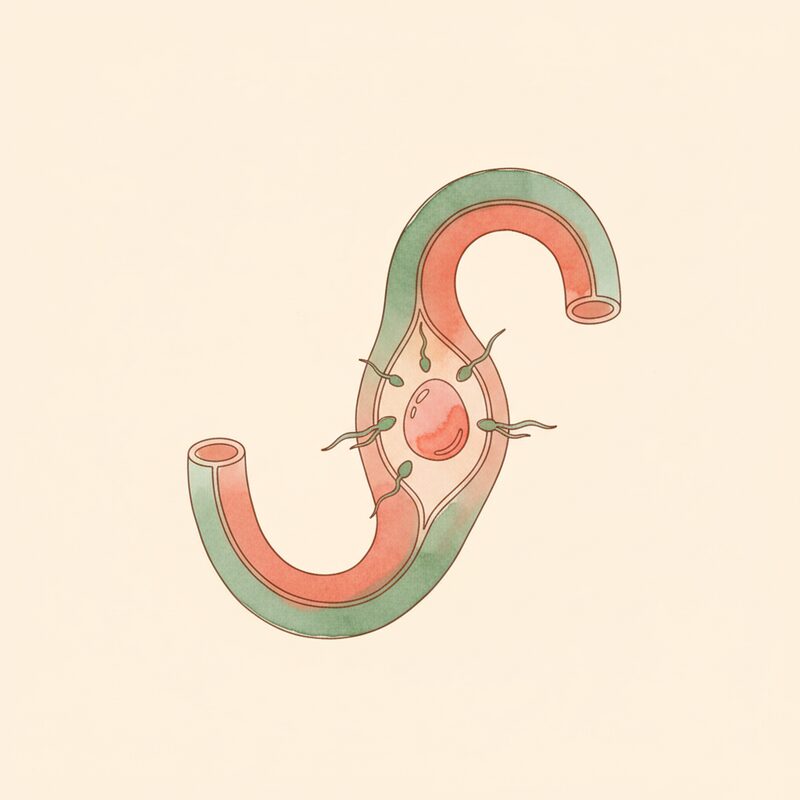
What are the fallopian tubes for?
The fallopian tubes do three essential jobs in conception: they pick up the egg from the ovary at ovulation; they're the site where sperm meets egg; and they transport the developing embryo to the uterus over a few days. When tubes are blocked, damaged, or removed, none of these can happen naturally.
IVF was originally developed for exactly this problem — bypassing damaged tubes by performing fertilisation in the lab and transferring the embryo directly to the uterus.
Causes of tubal damage
- Pelvic inflammatory disease (PID) — the single most common cause, often from chlamydia or gonorrhoea infections that occurred years ago without obvious symptoms.
- Endometriosis — severe disease can cause tubal damage and adhesions.
- Prior pelvic surgery — appendix rupture, ovarian cyst surgery, fibroid surgery, ectopic pregnancy management.
- Hydrosalpinx — a fluid-filled blocked tube, often from prior PID, that not only blocks but also harms IVF outcomes.
- Tuberculosis — in India, genital TB is an important and sometimes under-investigated cause of tubal damage.
- Congenital absence or anomaly — uncommon but real.
Hydrosalpinx — the specific subtype that matters most
Hydrosalpinx deserves its own paragraph. It's a fluid-filled tube where the distal end is blocked and inflammatory fluid accumulates over time. The fluid can intermittently leak back into the uterus and is toxic to embryos — it reduces IVF success rates by approximately half if untreated.
For this reason, women with hydrosalpinx going into IVF are strongly recommended to have the affected tube either removed (salpingectomy) or clipped (proximal tubal occlusion) before the cycle. Both procedures are laparoscopic, recovery is fast, and they restore IVF outcomes to expected levels.
How tubal status is evaluated
HSG (hysterosalpingography)
An X-ray procedure where contrast dye is injected through the cervix and tracked as it fills the uterine cavity and spills out through the fallopian tubes. The first-line test for tubal patency. Done in the early follicular phase. Mildly uncomfortable but well-tolerated with simple pain relief.
SSG / saline-infusion sonography
A radiation-free alternative using ultrasound and saline (sometimes with microbubble contrast). Comparable accuracy to HSG in expert hands.
Laparoscopy with chromopertubation
Direct visualisation of tubes during laparoscopy with blue dye injected through the cervix. The diagnostic gold standard, but invasive — reserved for cases where surgery is being considered or where imaging results are uncertain.
Treatment — IVF or surgery?
When IVF is the answer
- Both tubes blocked.
- Severe bilateral damage.
- Hydrosalpinx that doesn't respond to repair.
- Coexisting issues (advanced maternal age, severe male factor).
- Want a faster path to pregnancy.
When tubal surgery might be the right move
- Mild proximal block in a younger woman with otherwise normal fertility.
- Mild distal disease (fimbrial adhesions, mild hydrosalpinx amenable to fimbrioplasty).
- Reversal of prior tubal ligation (sterilisation reversal) in young women wanting multiple pregnancies.
Salpingectomy or clipping before IVF for hydrosalpinx
Standard of care — not optional — before IVF when hydrosalpinx is present. Improves IVF outcomes substantially.
How I work with tubal factor
- Confirm the diagnosis with appropriate imaging before recommending anything invasive.
- Treat hydrosalpinx before IVF. Always. The evidence is strong.
- Be honest about tubal repair. For severe bilateral damage, repair rarely restores function adequately and IVF is more efficient.
- Don't operate to operate. Some patients have been recommended invasive tubal surgery when IVF would have been faster, cheaper in real terms (factoring success rate), and less risky.
Concerned about tubal factor?
A consultation reviews imaging and gives you a clear path — whether that's IVF, surgery, or both.
Frequently asked questions
The questions patients ask me most often about blocked tubes.
How is tubal block diagnosed?
First-line: HSG (X-ray with contrast through the cervix). SSG (saline ultrasound) is a radiation-free alternative. Gold standard remains laparoscopy with chromopertubation but invasive — reserved for specific cases.
Is HSG painful?
Moderate cramping during the procedure, similar to a strong menstrual cramp, for a few minutes. Pre-procedure ibuprofen helps. Severe pain uncommon. Procedure takes 10–15 minutes. Most return to normal same day.
Can blocked tubes be fixed?
Sometimes — depending on location, cause, extent. Mild proximal blocks may clear with hysteroscopic cannulation. Mild distal disease addressable laparoscopically. Severe damage and bilateral hydrosalpinges generally not repairable to functional levels — IVF more efficient.
What's hydrosalpinx?
A fluid-filled, blocked tube. The inflammatory fluid leaks back into the uterus and harms embryo implantation. Reduces IVF success by ~50% if untreated. Treatment before IVF: salpingectomy or proximal tubal occlusion.
Should I have surgery before IVF?
Yes for hydrosalpinx — strong evidence supports salpingectomy or clipping before IVF. For non-hydrosalpinx tubal disease without natural-conception intention, surgery generally not needed.
Can I conceive naturally with one open tube?
Yes, often. With one open functional tube, natural conception possible — pregnancy rates reduced compared to two but not zero. Open tube needs to be on a side where ovulation can be picked up.
What if both tubes are blocked?
IVF is generally the right path. IVF bypasses tubes entirely. Tubal surgery rarely the right choice with severe bilateral blockage.
Does adhesiolysis help?
Helps when adhesions are the main barrier and tubes are otherwise healthy. Significant intrinsic tubal damage: adhesiolysis alone unlikely to meaningfully restore function — IVF more reliable.