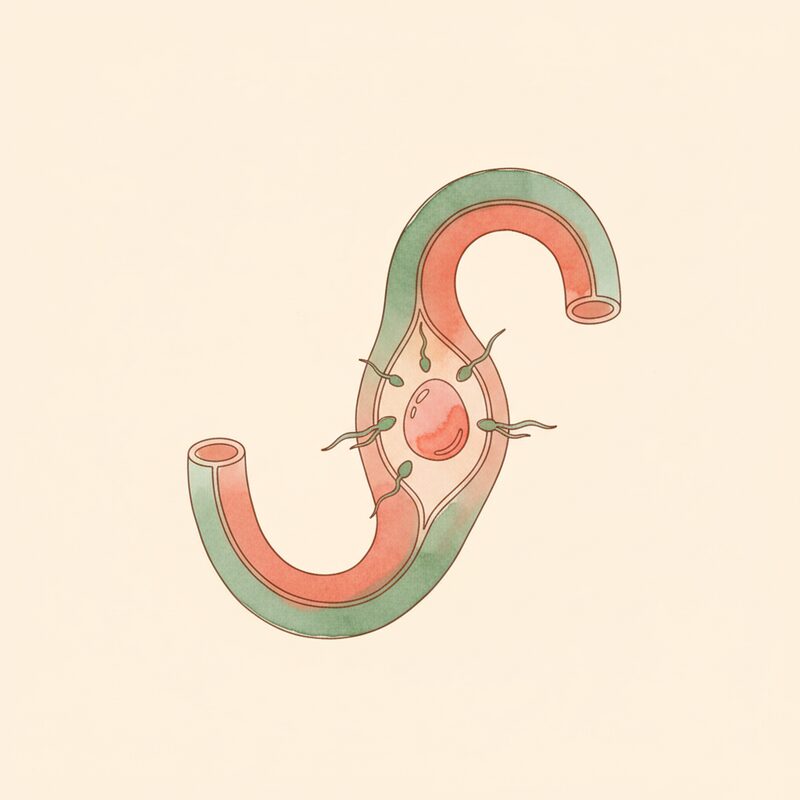
What is IUI?
IUI (intrauterine insemination) is a fertility procedure in which prepared, motile sperm is placed directly inside the uterus around the time of ovulation. By bypassing the cervix and depositing the strongest sperm closer to the fallopian tubes, IUI shortens the distance sperm need to travel and concentrates the effort right at the most fertile moment of the cycle.
IUI is the simplest fertility intervention with real, measurable success rates. It is much less invasive and much less expensive than IVF, and for many couples it is the first — and only — treatment they ever need.
Who is IUI for?
- Mild male factor infertility — reduced count, motility, or morphology that doesn't require ICSI.
- Ovulatory dysfunction, including PCOS, after restoring regular ovulation with medication.
- Mild endometriosis where the tubes remain open and the disease isn't extensive.
- Cervical factor infertility — thick cervical mucus or anatomic factors that hinder sperm transit.
- Unexplained infertility in women under 38 with a normal workup.
- Single parents or same-sex couples using donor sperm.
IUI requires at least one open fallopian tube. If both tubes are blocked or severely damaged, IUI cannot work; IVF is the right step.
How an IUI cycle works — step by step
- Cycle monitoring — Starting around day 9–10 of the cycle, transvaginal ultrasound tracks follicle growth. We confirm a mature follicle (about 18–22 mm) is developing.
- Ovulation trigger — When the follicle is mature, an hCG injection precisely times ovulation, typically 36 hours later.
- Sperm preparation — On the day of the insemination, a fresh semen sample is processed in the lab. The strongest, most motile sperm are concentrated; debris and seminal plasma are removed.
- The insemination — Prepared sperm is loaded into a thin catheter and passed through the cervix into the uterine cavity. The procedure takes about 5 minutes and feels like a routine pelvic exam.
- Luteal support — Progesterone is started after IUI to support the uterine lining for implantation.
- Pregnancy test — Beta hCG blood test 14 days after the insemination.
What to expect during a cycle
A typical IUI cycle is about two weeks from the start of monitoring to the pregnancy test. There are 2–3 short clinic visits for ultrasound monitoring. The insemination itself is brief and uncomfortable rather than painful. You can drive yourself home and return to normal activities the same day.
The two-week wait between insemination and pregnancy test is, as with any fertility cycle, the hardest part. Mild progesterone side effects (breast tenderness, bloating) are common and not a sign of pregnancy or its absence.
Success rates
Live-birth rate per IUI cycle varies by age and indication:
- Under 35: 10–15% per cycle, cumulative 35–40% over 3 cycles.
- 35–37: 8–12% per cycle.
- 38–40: 5–8% per cycle; we often recommend moving to IVF sooner.
- Over 40: typically less than 5%; IVF is usually the better path.
Adding ovulation induction with letrozole or clomiphene roughly doubles the per-cycle success compared to natural-cycle IUI in most indications.
What it costs in Hyderabad
A complete IUI cycle — including monitoring, medications, ovulation trigger, sperm preparation, and the procedure itself — typically costs ₹15,000 to ₹30,000 at most Hyderabad fertility centres in 2026. My consultation fee is ₹500; cycle pricing is set by KIMS Fertility.
IUI is roughly one-tenth the cost of an IVF cycle. For couples in whom IUI is genuinely indicated, this matters — both financially and emotionally.
When IUI isn't the right answer
IUI is not appropriate when:
- Both fallopian tubes are blocked or absent.
- Sperm parameters are severely reduced (total motile count below 5 million after preparation).
- The woman is 40 or older — time to a successful outcome matters more.
- Three properly conducted IUI cycles have already failed.
- There's a known genetic condition that requires PGT.
In these cases, IVF is the more efficient path. Insisting on IUI when it's not indicated wastes the most precious resource: time.
How I work
IUI is often skipped over in fertility clinics that prefer the higher-margin IVF cycle. I do the opposite. If your evaluation suggests IUI has a real chance, that's where we start. We'll plan 3 cycles up front, monitor each one carefully, and review honestly between cycles. If IUI works, we celebrate. If it doesn't after 3 cycles, we step up — without making you feel the previous cycles were wasted, because they weren't.
Wondering if IUI is right for you?
A consultation tells us whether IUI fits your specific picture — or whether to start somewhere else.
Frequently asked questions
Honest answers to the questions patients ask me most often about IUI.
How many IUI cycles should I try before moving to IVF?
The general guideline is 3 to 4 IUI cycles before considering IVF, provided each cycle was well-monitored and ovulation was confirmed. If you're over 38, we often move sooner. If 3 properly conducted IUI cycles haven't worked, the marginal benefit of more IUI cycles drops sharply and IVF becomes the more efficient next step.
Is IUI painful?
Not really. The procedure feels similar to a Pap smear — a thin catheter passed through the cervix into the uterus. Most women feel mild cramping for a few minutes; some feel nothing. No anaesthesia is needed. You can drive yourself home and return to normal activities the same day.
What's the success rate per IUI cycle?
Live-birth rate per cycle is typically 8–15%, depending on age and underlying diagnosis. Cumulative success across 3 cycles is meaningfully higher — often 30–40% in women under 35 with the right indication.
How is IUI different from IVF?
IUI keeps fertilisation inside your body. Prepared sperm is placed in the uterus; egg meets sperm in your fallopian tube. IVF is laboratory fertilisation — eggs and sperm are combined in a dish, and an embryo is transferred later. IUI is simpler, cheaper, less effective per cycle; IVF is more invasive, more expensive, substantially more effective per cycle.
Do I need ovulation induction with IUI?
Usually yes. Combining IUI with mild ovulation induction (letrozole or clomiphene) improves success compared to natural-cycle IUI in most indications. The exception is donor-sperm IUI in a woman with regular ovulation, where natural cycle is reasonable.
Can IUI work with low sperm count?
Yes, but only with mild reductions. IUI typically works when total motile sperm count after preparation is above 5 million. Below that, IUI success drops sharply and IVF or ICSI becomes the better option. Sperm DNA fragmentation also matters.
What does an IUI cycle cost in Hyderabad?
A complete cycle including monitoring, medications, ovulation trigger, sperm preparation, and the procedure typically costs ₹15,000–₹30,000 at most Hyderabad fertility centres in 2026. My consultation fee is ₹500; cycle pricing is handled by KIMS Fertility.
What happens if 3 IUI cycles fail?
Three failed IUI cycles with confirmed ovulation and good timing is a signal to step up — not repeat the same approach. We review whether the workup was complete, consider laparoscopy or hysteroscopy if there's suspicion of subtle factors, and discuss moving to IVF. Continuing IUI beyond cycle 4 rarely changes outcomes.