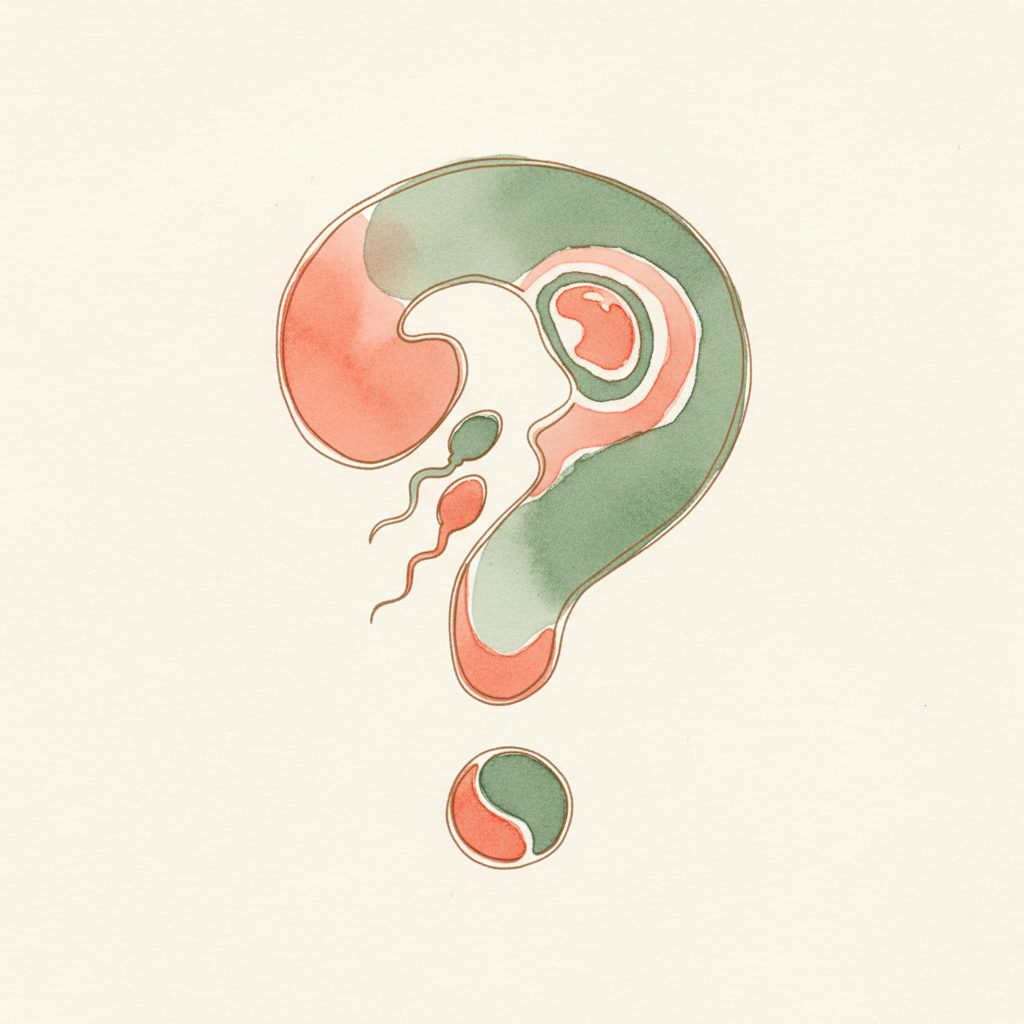
What is unexplained infertility?
Unexplained infertility is a diagnosis of exclusion. After a complete fertility workup — ovulation confirmation, hormone profiles, tubal patency check, semen analysis, ultrasound — everything is normal, but conception still hasn't happened after 12 or more months of regular unprotected intercourse.
It is one of the most emotionally difficult diagnoses to receive. Couples want a cause they can fix. When the tests come back normal and the doctor says "we don't know why", the response is often a mix of relief (nothing is wrong) and frustration (then why isn't it working?). Both are valid.
What's in the standard workup
The complete workup before labelling something "unexplained" should include:
- Ovulation confirmation — mid-luteal progesterone or follicular monitoring.
- Ovarian reserve — AMH and antral follicle count.
- Baseline hormones — FSH, LH, oestradiol on day 2 or 3.
- Prolactin and thyroid.
- Tubal patency — HSG or SSG; selectively, laparoscopy.
- Uterine cavity — ultrasound, sometimes hysteroscopy.
- Semen analysis — WHO 2021 criteria, ideally repeated.
If any of these are abnormal, you don't have "unexplained" infertility — you have a specific diagnosis that should drive treatment.
Why some causes elude the standard workup
Several real causes don't show up on routine testing:
- Subtle endometriosis — not visible on imaging, only on laparoscopy.
- Sperm DNA fragmentation — not part of standard semen analysis.
- Egg quality — we can count eggs but can't routinely test their quality.
- Subtle ovulatory dysfunction — periods regular but the egg may not be fully mature.
- Implantation factors — window timing, endometrial receptivity.
- Immune factors — some, especially antiphospholipid antibodies.
For most couples, identifying these doesn't change first-line treatment, which is why we don't routinely test for them.
Treatment options — the stepwise approach
Expectant management
Continuing to try, with timed intercourse and ovulation tracking. Reasonable for couples under 35 who've been trying less than 18–24 months. Spontaneous conception still occurs in unexplained infertility — about 1–3% per cycle, around 30–40% cumulative over 2 years.
Ovulation induction + IUI
First-line active treatment. Letrozole or clomiphene with IUI roughly doubles per-cycle success compared to natural cycles. Cumulative 3–4-cycle success: 30–40% in women under 35.
IVF
The next step when IUI hasn't worked, or first-line for women 38 and older. IVF also surfaces information — fertilisation rate, embryo development, implantation — that the original workup didn't.
When to step up
Don't keep doing the same thing indefinitely. Reasonable inflection points:
- Under 35: 3–4 IUI cycles, then IVF.
- 35–38: 2–3 IUI cycles, then IVF.
- Over 38: IUI is often skipped; we move to IVF sooner.
The "more testing" trap
Couples with unexplained infertility often want more testing. The honest truth: most additional tests — extensive immune panels, NK cells, advanced sperm tests, ERA, etc. — have weak evidence as first-line. They sometimes find something, but rarely change what we'd do.
Endless testing without action is a real trap. We focus on what will change the next step.
How I work with unexplained infertility
- Confirm the workup is genuinely complete. Make sure nothing was missed before accepting the "unexplained" label.
- Be realistic about time. Above 35, don't burn months on low-yield expectant management.
- Move forward stepwise, not aimlessly. 3 cycles of OI+IUI, then IVF. Clear inflection points.
- Resist endless testing. Add tests only when they'd change management.
Tests normal but still not pregnant?
A consultation gives you a clear stepwise plan, not more tests.
Frequently asked questions
The questions patients ask me most often about unexplained infertility.
What does unexplained really mean?
Standard workup normal — regular ovulation, open tubes, normal sperm, no uterine or hormonal issue. Doesn't mean there's no cause; only that no cause can be identified with standard tests. ~10–15% of infertility.
How thorough should my workup be?
Ovulation confirmation, AMH/AFC, day-2/3 hormones, prolactin, thyroid, semen analysis, tubal patency. Hysteroscopy in selected cases. Genetic and immune testing rarely change management for first-time unexplained.
Should I keep trying naturally?
Depends on age and duration. Under 35 trying <18–24 months: expectant reasonable. Above 35: active treatment after 6 months. Above 38: sooner. Don't burn months that count.
OI/IUI or jump to IVF?
Under 38: OI+IUI reasonable first-line, cumulative 30–40% over 3–4 cycles. 38+ or after failed IUI: IVF gives better per-cycle outcomes. IUI step not required if you'd rather go direct to IVF.
How long can it stay unexplained?
Diagnostic uncertainty can persist. Sometimes IVF itself reveals causes (poor fertilisation, embryo arrest, implantation) not visible on standard tests. ~50% of unexplained couples get a more specific diagnosis during treatment.
What if 3 IUIs fail?
3 properly conducted IUIs with confirmed ovulation is a reasonable inflection. Marginal benefit drops sharply after. Most move to IVF, particularly with age 35+. Continuing IUI beyond cycle 4 rarely changes outcomes.
Will more testing find a cause?
Often no. Beyond standard workup, additional tests sometimes find something but rarely change management. Endless testing without action is a trap. Add tests selectively when they'd change treatment.
Is immune testing worth it?
APS testing reasonable with recurrent loss or RIF. Routine immune testing for first-time unexplained has weak evidence and rarely changes management. We don't pursue speculative testing.